
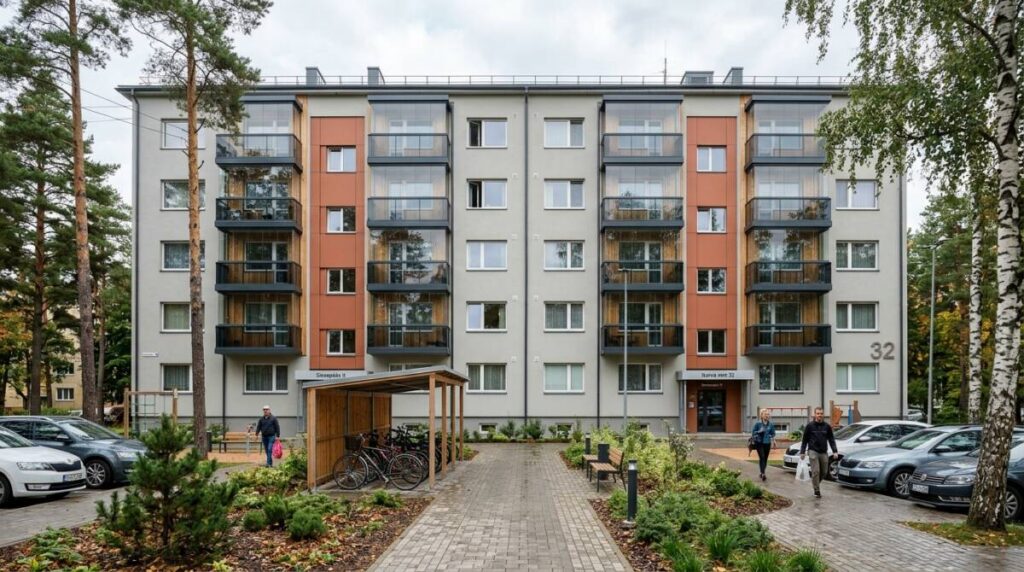
Apartment Building Renovation with KredEx (EIS) Grants in Ida-Virumaa: Impact on Utility Bills and Property Value
Between 85% and 90% of the housing stock in Narva, Sillamäe, Kohtla-Järve, and Jõhvi consists of brick and concrete panel apartment buildings constructed between the 1950s and 1980s. Structurally, many of these buildings retain solid load-bearing capacity, but their engineering systems and thermal insulation were designed in an era of cheap energy.
Today, the Estonian Business and Innovation Agency (EIS — Ettevõtluse ja Innovatsiooni Sihtasutus, formerly KredEx) allocates dedicated quotas and enhanced grant rates specifically for Ida-Virumaa to help apartment associations carry out comprehensive or partial renovations. For both buyers and sellers in the regional property market, a building's renovation status has become one of the primary drivers of price and liquidity.
1. How Does "Partial Repair" Differ from Comprehensive KredEx (EIS) Renovation?
When browsing property listings, the visual contrast is striking: some apartment blocks look like modern Scandinavian new-builds with uniform balcony glazing and fresh-air intake valves, while others simply have plastered and painted end walls.
In the Ida-Virumaa market, you will typically encounter three levels of building modernization:
| Modernization Level | Typical Scope of Works | Impact on Residents and Apartment Value |
|---|---|---|
| Basic Maintenance (Self-Funded by KÜ) | Repaired bitumen roof, insulated cold end walls only, replaced stairwell windows and entrance doors, upgraded heating substation | Eliminates leaks and drafts in corner units, reduces heat consumption by 10–15%, and usually leaves the building with no bank loan. |
| Partial Renovation | Full facade and plinth insulation, roof overhaul, heating system balancing, replacement of water and sewer risers | Heat savings of 25–35%, steady indoor winter temperatures (+21…+22 °C), and elimination of dampness on ground and top floors. |
| Comprehensive Renovation with EIS (KredEx) Grant | Full facade and roof insulation, replacement of all windows (or moving them into the insulation plane), two-pipe heating system with individual thermostats, mechanical ventilation with heat recovery, and often rooftop solar panels | Heating savings of 40–55%, healthy indoor air free of mold or window condensation, upgraded energy performance certificate to Class C or B, and maximum resale liquidity. |
2. Why Are Renovation Grant Terms More Favorable in Ida-Virumaa Than in Tallinn?
In major cities like Tallinn and Tartu, market prices per square meter are high, making it relatively easy for apartment associations to secure commercial bank loans even with a smaller state subsidy share. In Ida-Virumaa, property market values are lower, yet construction materials and contractor labor cost the same as anywhere else in Estonia.
To bridge this gap, regional support measures for Ida-Virumaa offer:
- Higher non-repayable grant percentages (up to 50% or more, depending on the depth of renovation and the specific funding round);
- Direct loans from EIS (KredEx) in cases where commercial banks are hesitant to finance an apartment association in a smaller municipality.
As a result, the monthly loan repayment for an apartment owner in Ida-Virumaa remains manageable and is largely offset by reduced winter heating bills.
3. The Buyer's Biggest Fear: "The Building Has a Large Loan—Will I Overpay?"
A common question during viewings in Narva and Sillamäe is: "Why should I buy an apartment in a building where I have to pay €45 a month toward a KredEx loan when the building next door has no loan at all?"
Let's run the numbers on an illustrative example of a two-room apartment (48 m²) in January:
- Unrenovated Building Without a Loan:
- Heating in a freezing month: €115
- Repair fund (for patching old pipes and roof leaks): €29 (€0.60/m²)
- Total for these two lines: €144—while corner rooms remain chilly and the exterior looks dated.
- Renovated Building With a Loan:
- Heating (after facade insulation and new thermostatic radiators): €55
- Loan repayment + repair fund: €60
- Total for these two lines: €115—while the apartment enjoys fresh, warm air via heat-recovery ventilation, new windows, a clean facade, and virtually zero risk of sudden plumbing emergencies.
Even if summer bills in a renovated building are slightly higher due to the year-round loan schedule, total annual costs are comparable, while living comfort and the capital value of the property are substantially higher.
4. How Does the Energy Performance Class (A–G) Affect Mortgages?
If you are financing your purchase with a home loan (or plan to sell the apartment to a mortgage buyer a few years down the road), the building's energy label (energiamärgis) in the Estonian Register of Buildings (Ehitisregister) has direct financial consequences:
- Major banks in Estonia (Swedbank, SEB, LHV, Coop, Luminor) increasingly offer favorable "green" lending terms: for buildings with high energy efficiency ratings (Class A, B, or C) or comprehensive renovations, banks are more willing to approve collateral and sometimes offer reduced interest margins.
- Certified property appraisers preparing an official valuation report (hindamisakt) factor the condition of the facade, roof, and technical systems directly into a higher market valuation for the apartment.
5. What Should You Check If a Building Is Preparing for Renovation?
Buying an apartment in a building where the KÜ general meeting has already voted to renovate, the engineering design is ready, and an EIS grant application has been submitted—before construction actually begins—can be a smart investment:
- Ask the association chair about the exact stage of the project (whether the energy audit is complete, the building design is approved, and financing is confirmed).
- Clarify whether radiators and ventilation ducts inside individual apartments will be replaced during the works—this is crucial to know before starting your own interior remodeling.